


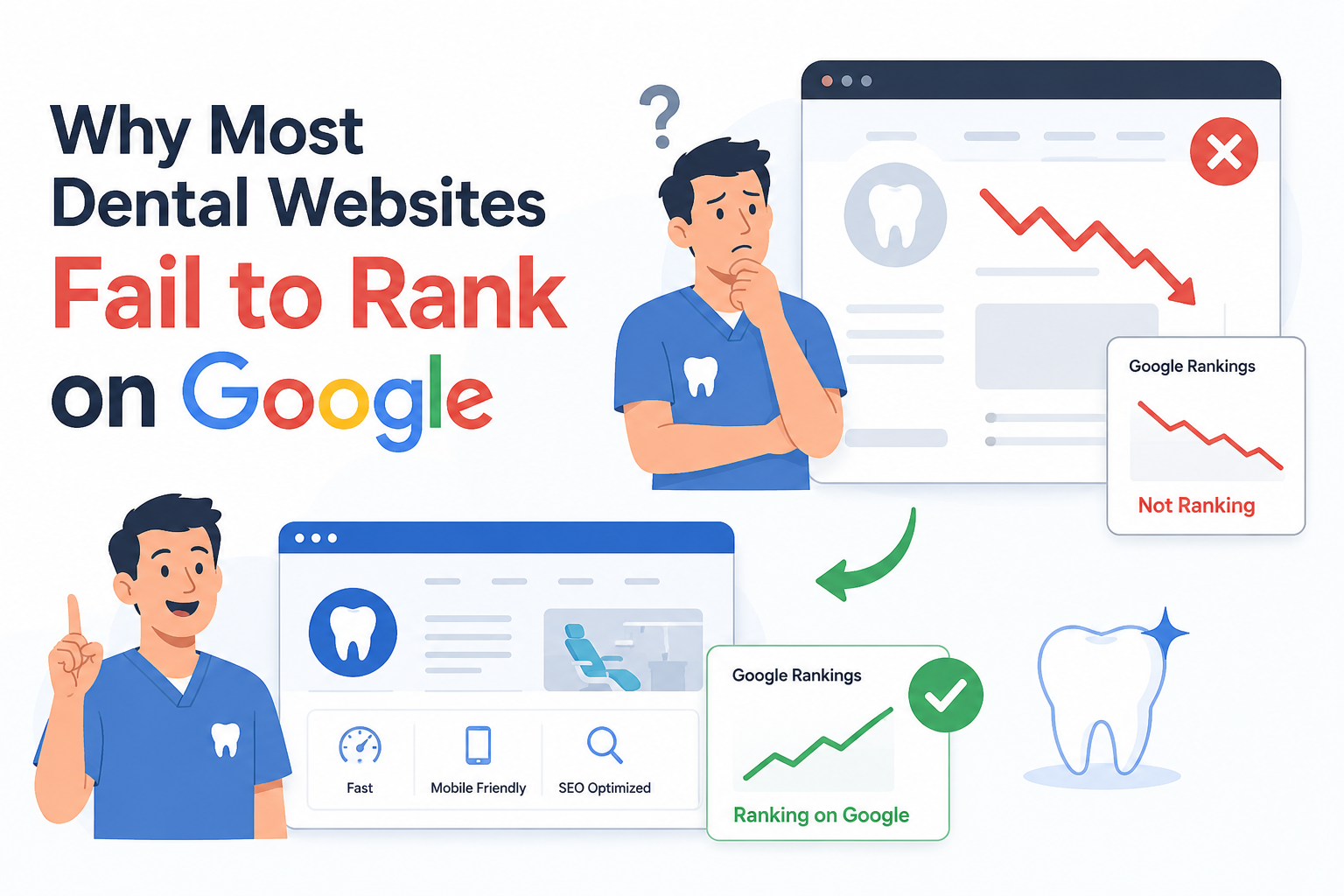
Does your dental website not make it to the Google results page or drive new patients to your website?
If yes, you aren’t the only one, and this is one of the most frequent challenges dental clinics experience today. There are stunning dental websites that don’t show up on the first page of Google when people are searching for your services, like dental implants, teeth whitening, braces or emergency dentistry.
In this guide, you will learn why most dental websites don’t rank on Google, and what is going on with your website that you are not seeing results.
Why Most Dental Websites Fail to Rank on Google
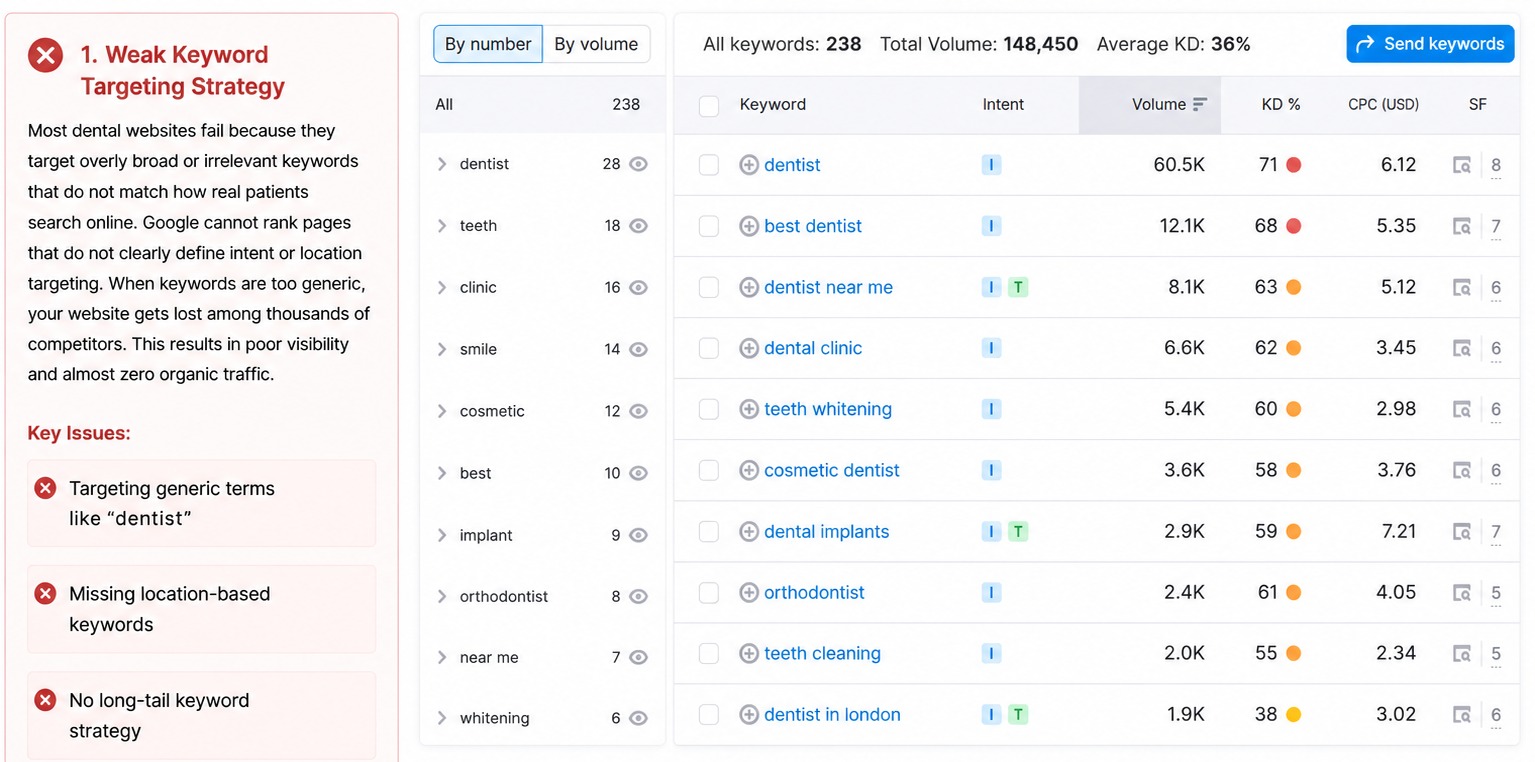
1. Weak Keyword Targeting Strategy
Because most dental websites aim for broad keywords or keywords that are inapplicable to their services, they don’t rank well on search engines, and that means they always fail to attract patients to their websites. Without intent and targeting settings as defined on the web page, Google can’t rank any pages.
If keywords are too impersonal, your website is drowned in the thousands of other sites that already exist. This leads to poor searchability and virtually no organic traffic.
Key Issues:
- Targeting generic terms such as “dentist”
- Missing location-based keywords
- Do not have a long tail optimisation strategy.
2. Poor Local SEO Optimisation
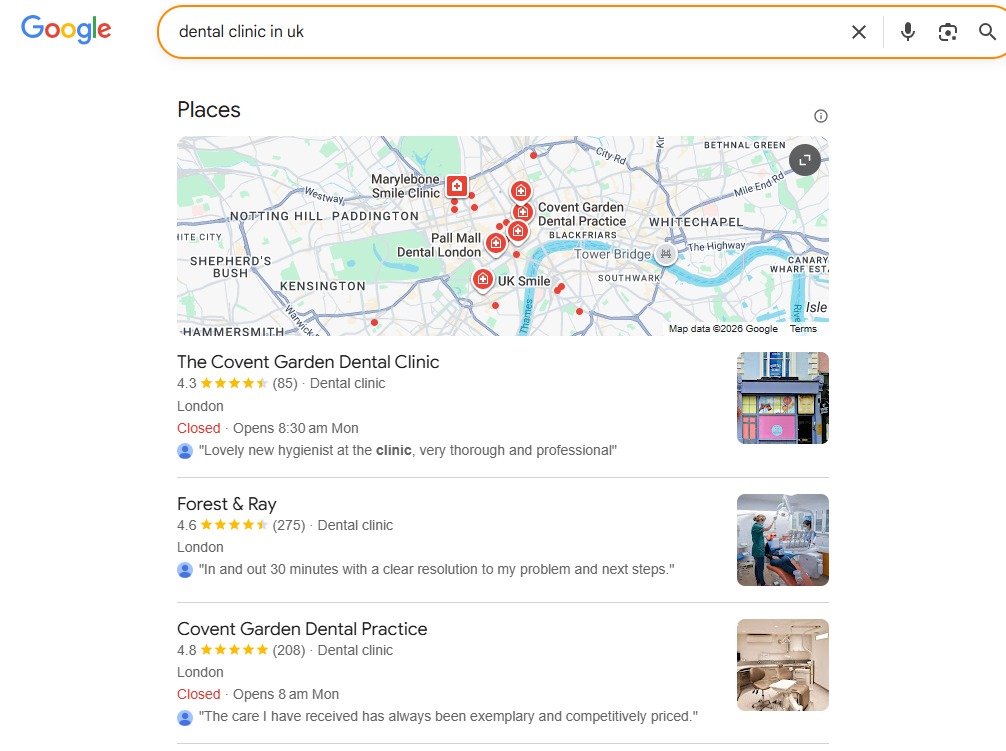
While local SEO is the backbone of dental marketing, very few dental practices get it right. Local optimisation is essential for your website to show up in “near me” searches or Google Maps results; you won’t have them.
Patients typically select clinics located around them, resulting in an opportunity to lose business by not having local SEO. One of the most important ranking signals.
Most dental websites miss:
- No Google Business Profile optimisation
- Missing local citations
- No city-specific landing pages
- Inconsistent business information
3. Low-Quality or Thin Content
While content is one of the best-ranking factors, most dental websites have either very little content or duplicated content. Google cannot rank pages of a few hundred words. Google can’t rank pages of a couple of hundred words.
No one can put trust in the clinic unless patients get a detailed explanation beforehand. A website that has no in-depth content is weak and unhelpful to the search engine.
Key Issues:
- 300–500-word service pages
- Copied or generic descriptions
- No educational content
- Lack of FAQs and depth
4. No Backlinks or Authority Signals
For Google, backlinks serve as a signal of credibility and the legitimacy of a website. The only thing most of the dental site pages have is essentially zero backlinks, and they aren’t visible in competitive search results. Design is good, but if it is not authorised, then it is not competitive. Backlinks are invaluable tools for internet marketing reputation building, as well as world ranking power.
Key Issues:
- No external website mentions
- No dental directory listings
- No guest posting strategy
- Lack of authority building
5. Technical SEO Issues
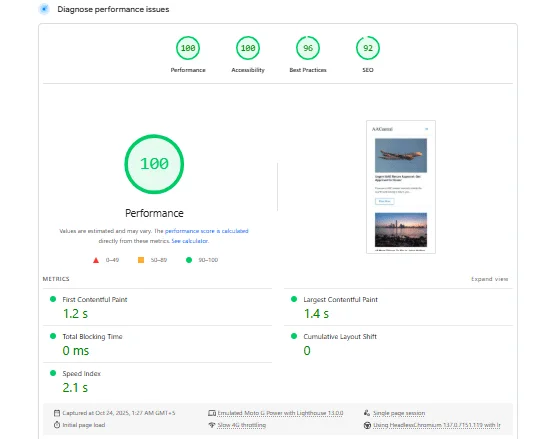
Multiple hidden technical issues could be damaging many dental websites without them knowing. Technical errors prevent Google from being able to crawl and index it, even when it has good content.
Slow speed, mobile issues, and broken pages result in poor user experience and adversely impact ranking potential.
Key Issues:
- Slow website loading speed
- Poor mobile responsiveness
- Broken links and errors
- Weak site structure
6. Weak On-Page SEO Optimisation
On-page SEO is crucial to Google’s ability to recognise your content, but the vast majority of dental websites don’t optimise it properly. By inserting keywords logically and clearly into your pages and using structured headings, search engines can determine the relevance of your page. Every page must be optimised for what people are looking for on page optimisation.
Key Issues:
- Missing optimised title tags
- Improper H1, H2, H3 structure
- No internal linking
- Missing image alt text
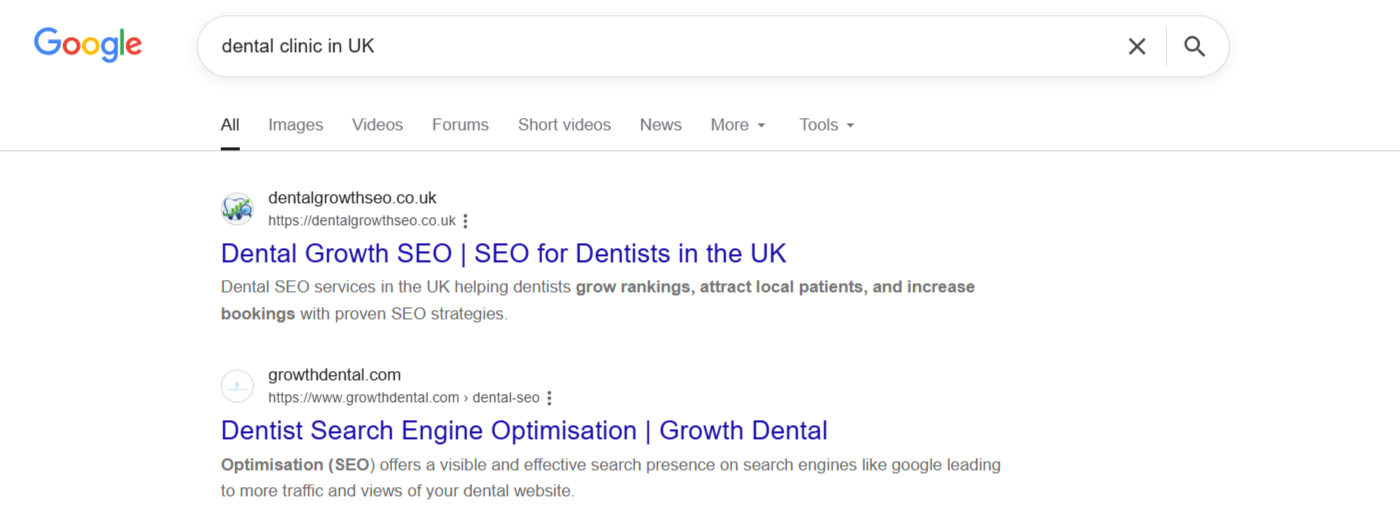
How Dental Growth SEO Helps Your Clinic Grow
At Dental Growth SEO, the focus is on helping dental clinics improve their online visibility through structured and results-driven SEO strategies.
The approach includes:
- Complete dental SEO optimisation
- Local search ranking improvement
- High-quality content development
- Technical SEO enhancements
- Patient-focused growth strategies
The initial task is to improve dental office visibility, drive more traffic, and establish long-term digital authority.
How to Fix Dental Website SEO Problems
Step 1: Build a Strong Keyword Strategy
A successful dental SEO strategy starts with proper keyword research. Using keywords which are searchable among patients is important, as is using location-specific keywords and question-specific keywords.
- Service + location keywords
- Long-tail search phrases
- Patient question keywords
Step 2: Create High-Quality SEO Pages
Remember to keep each service page as a detailed and authoritative resource and not just a description. It helps to establish trust with users and Google.
- 1500–3000 words per page
- Detailed treatment explanations
- FAQs and supporting content
- Linking pages internally
Step 3: Strengthen Local SEO
Local SEO is crucial for making local patients aware of your services. When your clinic has a high local presence, it shows up in Google Maps and local search results.
- Optimise Google Business Profile
- Collect and manage patient reviews
- Build local citations
- Create location-based pages
Step 4: Build High-Quality Backlinks
Backlinks improve your website’s authority and help it rank higher in competitive searches. A consistent backlink strategy is essential for long-term SEO success.
- Dental directories and listings
- Guest posts on relevant websites
- Local business partnerships
Step 5: Improve Technical SEO
The better a site performs technically, the better it attracts search engine results and the better it is for people using the website. Google favours sites that are speedy and ideal for mobile devices.
- Improve page speed
- Ensure mobile optimisation
- Fix broken links
- Improve site structure
Frequently Asked Questions (FAQs)
1. Why is my dental website not ranking on Google?
Most Dental Websites fail to rank because they are under-optimised and have a weak keyword and thin content, and they don’t optimise them based on the local keyword.
2. How long does it take to position a dental web page?
Typically, you need to wait 3-6 months to see results from any competition or from SEO quality. Optimisation, content and backlinks need to be consistent to secure a stable ranking.
3. What is the most crucial SEO element?
The most important factor is local SEO. Optimising your Google Business Profile and using location-based keywords will go a long way to ensuring that your clinic is found in the “near me” results and on Google Maps.
4. Is SEO going to attract more patients to my Dental clinic?
Yes. SEO increases your website’s visibility on Google, generating an increased number of patients looking for dental care services in your area. Higher Rankings translate into more calls, bookings and enquiries.
Final Thoughts
If you don’t rank on Google with your dental website, then it is, for the most part, a matter of SEO, and not design! Problems like weak keyword targeting, not optimising your local SEO, a page or site being thin, and not having authority signals in your pages keep your clinic from being visible to people looking for dental services in your neighbourhood. In order to ensure more visibility and higher growth in patients, your website should be optimised as per Google’s ranking criteria. Dental Growth SEO enhances the online presence and rankings of dental practices.