

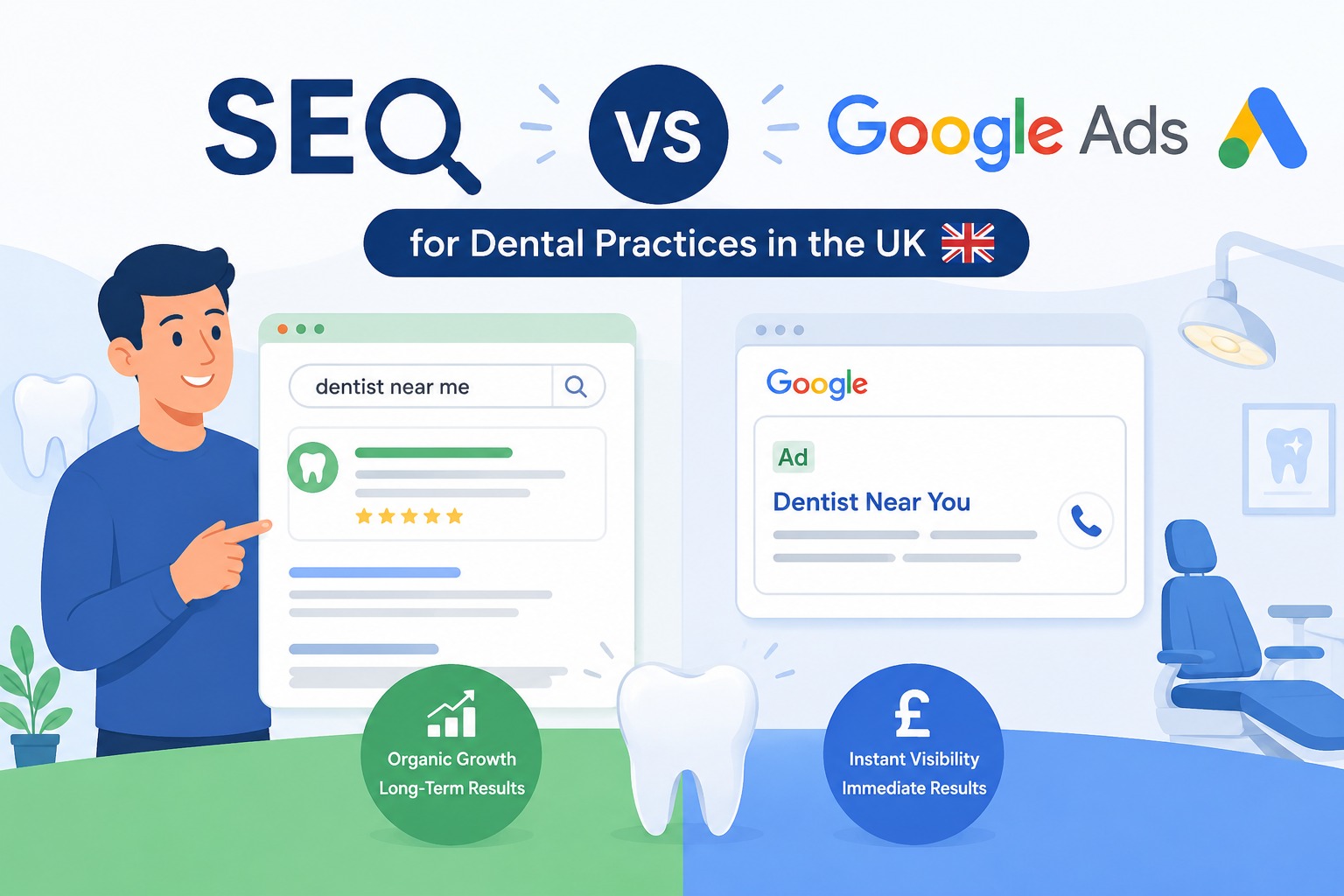
Are you confused about making decisions regarding how to invest your marketing budget in future – SEO or Google Ads? You are not alone. Many dental offices are in a similar situation day after day – spending money to get patients into their seats, but getting very few results in the form of consistent patient appointments and ultimately patient growth. In reality, patients can be found through SEO and Google Ads methods, but they’re very different. One gives you instant visibility, and the other will create authority and sustainable patient traffic.
If you’re a dentist and you’re looking to grow your dental practice in the UK for 2026 and beyond, then you need to understand the difference between SEO and Google Ads. Whether you realise it or not, SEO and Google Ads are two distinct strategies that can be used to grow your dental practice in the UK for 2026 and beyond.
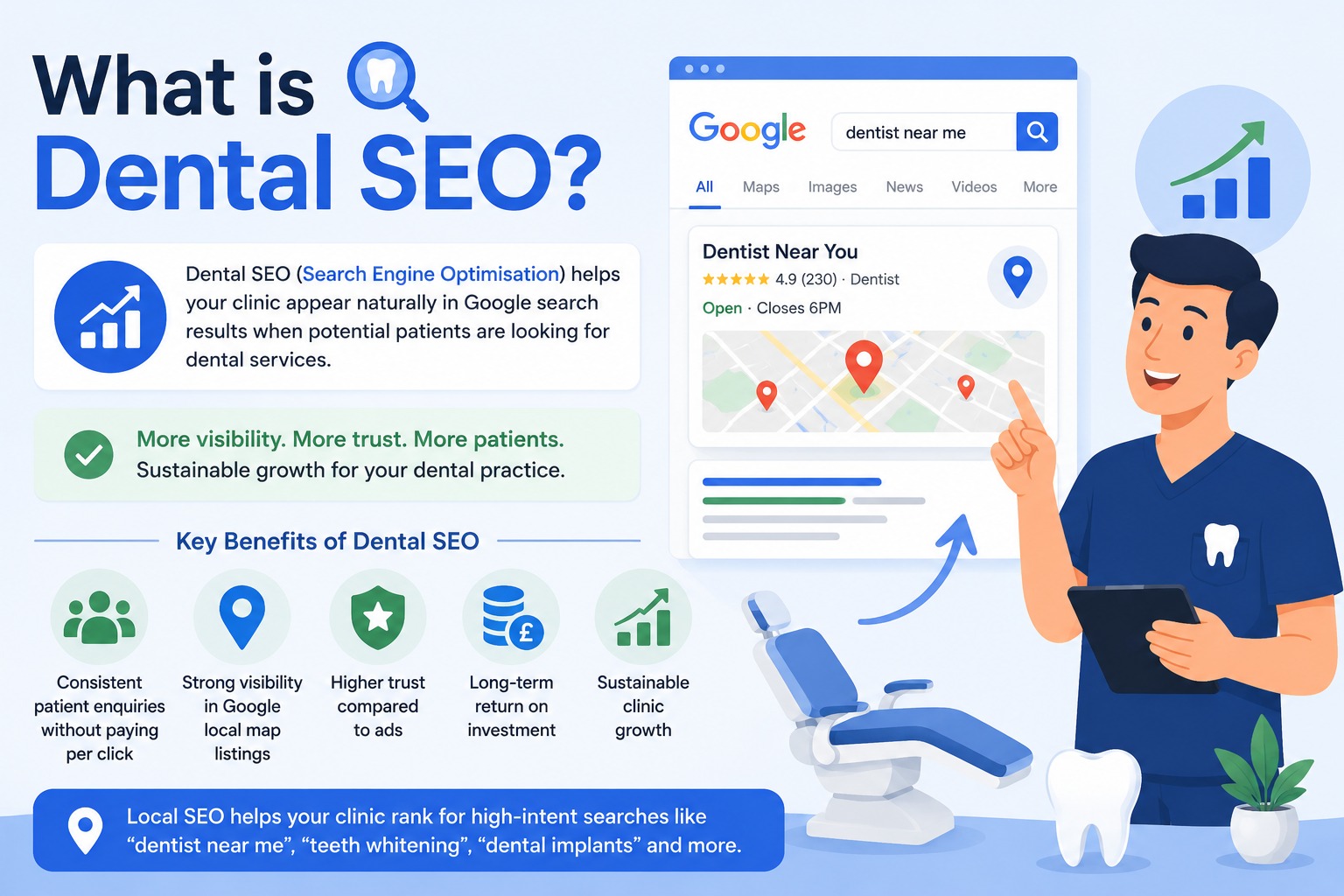
What is Dental SEO?
Dental SEO (Search Engine Optimisation) involves optimising a dental practice’s website to ensure it ranks organically in Google search results when people are actively seeking dental care. Unlike pay-per-click, SEO works to help your clinic get an organic ranking for high-intent keywords like teeth whitening, dental implants, emergency dental care, Invisalign treatment, or routine dental check-ups.
This means that your clinic won’t have to invest the cost in every single visit, and you can find new patients consistently. You can use this as a more sustainable and scalable marketing strategy in a UK dental office.
Key Benefits of Dental SEO
- Comprehensive queries from patients without click costs
- Excellent listing visibility in the Google local listings.
- Ads have lower trust than higher.
- Long-term return on investment
- Sustainable clinic growth
One reason why local SEO is so relevant for those in the dental industry is that many people create a search query of “dentist near me. ”This is because so many people use location-specific search queries, or ask for a “dentist near me.”
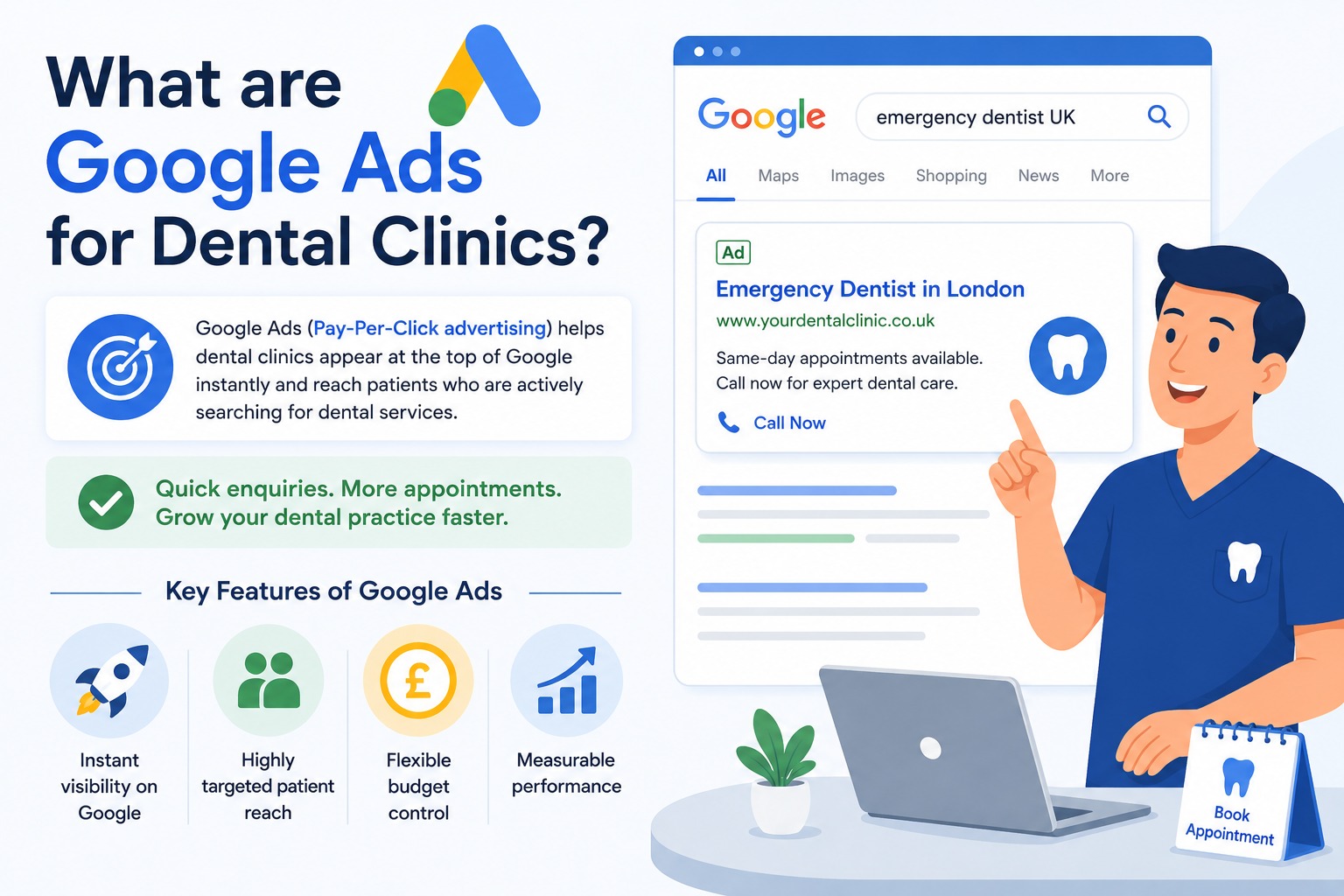
What are Google Ads for Dental Clinics?
Google Ads (Pay-Per-Click) search advertising with Google Ads puts dental practices in the top positions of Google search results pages in nearly no time. In the meantime, instead of relying on natural rankings, clinics can invest in advertising when their target audience is actively seeking their services. For example, when someone searches for an emergency dentist in the UK, clinics can adapt and show their ads.
Google Ads can be set up to lead to short-term enquiries, phone calls, and forum bookings for patients in a certain position to see and also target specific keywords, locations and patient needs.
Key Features of Google Ads
- Instant visibility on Google
- Highly targeted patient reach
- Flexible budget control
- Measurable performance
SEO vs Google Ads – Full Comparison for Dental Practices
When making a choice, it helps when you have this comparison, below, to help you make an informed decision:
| Factor | Dental SEO | Google Ads |
| Cost | Requires long-term investment but builds lasting value | Pay-per-click model, where the cost continues for every visit |
| Speed of Results | Takes time (around 3–6 months to show strong results) | Delivers instant visibility and immediate traffic |
| Sustainability | Highly sustainable and continues generating traffic long-term | Stops immediately when advertising budget is paused |
| Trust Level | Higher trust as patients prefer organic search results | Moderate trust since users know it is paid advertising |
| ROI (Return on Investment) | Improves and increases over time as rankings grow | Limited ROI as costs continue with ongoing campaigns |
| Long-Term Value | Builds a strong digital asset for your clinic | Provides short-term traffic and immediate leads |
Which One Brings More Dental Patients?
The reply is contingent on the point of your dental work.
New Dental Clinics
Google Ads are great for kick-starting patient queries for those just starting. It gives immediate visibility during the process of building up a website’s authority.
Established Dental Clinics
Optimising a website for search engines is even more effective when your clinic has already been open, creating the high probability of establishing trust and patient acquisition over the long-term.
Long-Term Growth Strategy
SEO is the king of sustainability as it will still earn inquiries if marketing activities are curtailed.
How to Build Dental SEO
Step 1: Find the Right Keywords
What patients are looking for – for example, “dentist near me”, “dental implants UK”, or “emergency dentist.” These words catch relevant patient searches.
Step 2: Optimise Your Website
Use the proper headings, service pages available and quick loading times; titles and descriptions for their website optimised for SEO.
Step 3: Focus on Local SEO
Optimise your Google Business Profile, upload your clinic information, put pictures and get reviews from patients to increase your presence on Google Maps and search.
Step 4: Publish Helpful Content
Develop straightforward and helpful blogs that respond to questions posed by patients concerning treatments and procedures and dental care. This enhances the security and hence boosts the ranking.
Step 5: Build Quality Backlinks
Connect with links built on trusted websites, local directories, and dental-relevant websites to build the website’s credibility and boost rankings over time.
Real-World Dental Marketing in the UK
Of course, many practices do invest in digital marketing, and they just can’t make patients keep moving in because they fail to grasp the distinction between advertising and investing in SEO in the long run.
Google Ads Cost for Dental Clinics
With dental services in the UK being so competitive online, the pages of Google Ads that focus on these can become even more competitive for high-priced services like dental implants, Invisalign and emergency dentistry. There is no fixed cost, and it is subject to much variation, depending on several variables:
- Type of dental service being advertised
- Geographic location of the clinic
- Level of competition in the area
Frequently Asked Questions (FAQs)
Is SEO better than Google Ads for dentists?
SEO is generally better for long-term patient growth, while Google Ads is effective for generating immediate enquiries.
How long does dental SEO take to show results?
If lack of optimisation and competition are the problem, the majority of dental websites will eventually start to improve after 3 to 6 months, but one may notice the improvement sooner.
Are Google Ads worth it for dental clinics?
Yes, with proper management that involves proper targeting, landing page, and conversion tracking.
What marketing campaign would you use to promote your dental practice in the UK?
The best solution is a combination – SEO is the base, and Google Ads can be used as a tinder to fire it up if you want to acquire more patients in the short-term.
Final Conclusion
Dental hygiene steps or dental treatment are the second most important process that helps the clinic get new patient potential. To conclude, both SEO and Google Ads are important processes for dental examination steps that are employed to get your clinic new patients in the UK, and they are very different, anyway. Google Ads can provide instant visibility and instant patient enquiries, and so make use of it for short time frames.
As time goes by, SEO proves to be the most valuable resource for any dental office, as it allows patients to find them even if the advert is not paid, and also helps to make sure that the patients’ flow is consistent and predictable.